
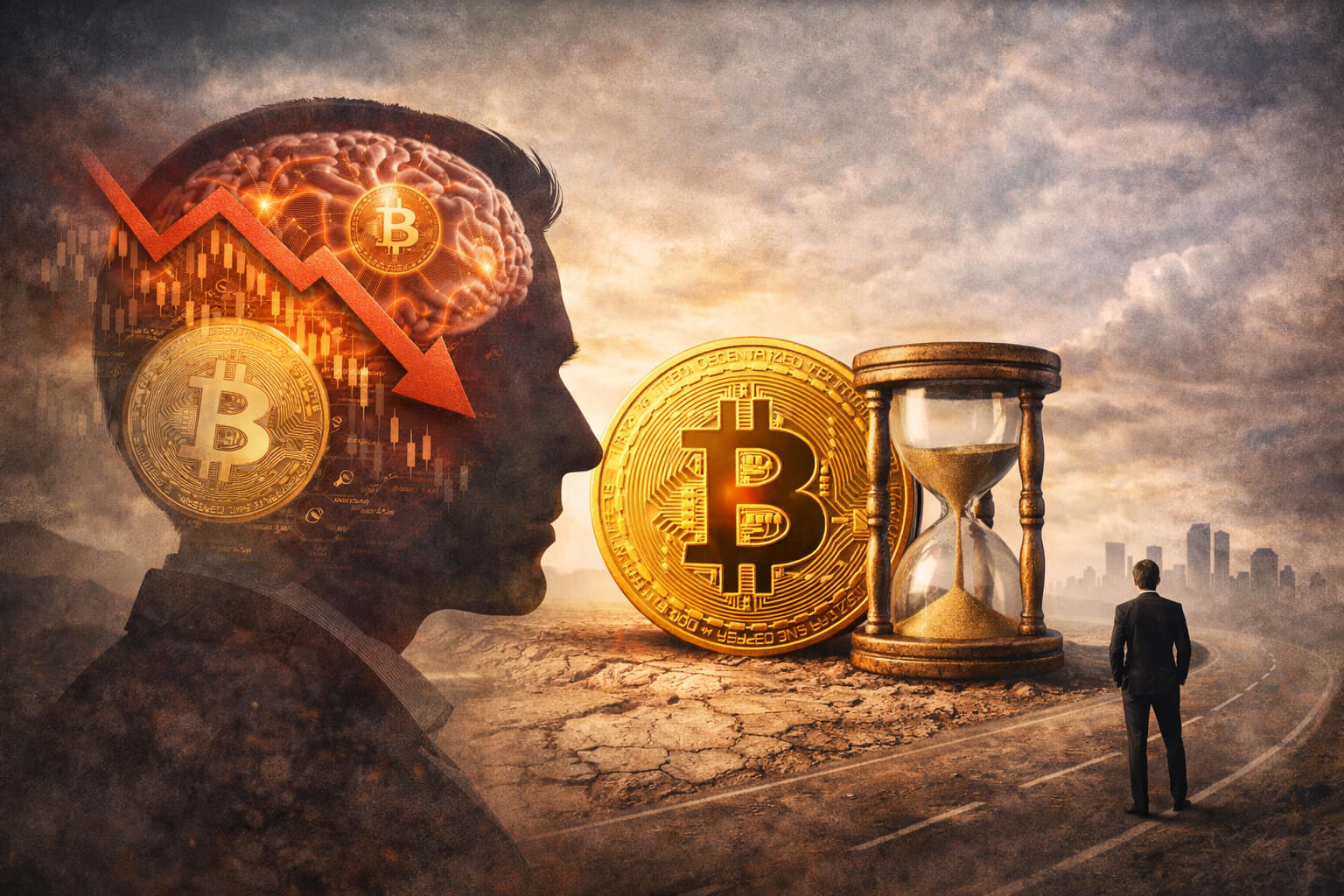
Let me be straight with you. I have been trading for years, and I have watched the same conversation repeat itself at every single price milestone Bitcoin has ever hit.
- At $1, people said the early adopters already made all the money.
- At $100, forums were flooded with posts calling it a bubble.
- At $1,000, mainstream media ran headlines about tulip mania.
- At $10,000, Wall Street suits called it “rat poison.”
- At $100,000, your coworker told you it was too risky to touch now.
And today? The same people are saying the same thing.
This is not a Bitcoin story. This is a human story. Our brains are wired to feel loss more sharply than gain, which means we fixate on what we did not buy rather than what we can still do. The “I missed it” feeling is one of the most expensive emotional patterns in investing. It keeps people frozen while the world moves forward.
The question is not whether you missed something. The question is whether the next chapter of this story has already been written, or whether you are still early enough to be in it.
Where Bitcoin Stands Today (The Numbers)
Before we get into opinions, let us look at facts. Here is what Bitcoin’s price history actually shows:
| Year | Price (approx.) | What Happened |
|---|---|---|
| 2010 | $0.001 | First real-world transaction: 10,000 BTC for two pizzas |
| 2013 | $1,238 | First mainstream media wave |
| 2017 | $19,000 | First retail investor boom |
| 2020 | $29,000 | MicroStrategy and institutional buyers enter |
| 2021 | $69,000 | Tesla buys BTC; Coinbase goes public |
| 2024 | $108,000+ | US spot Bitcoin ETFs approved; 4th halving happens |
| 2025 | $126,000 (ATH) | ETF inflows hit $55B+; Strategic Bitcoin Reserve proposed |
| 2026 | ~$71,000–$75,000 | Post-peak correction; market stabilizing |
Sources: Coinbase, Bankrate, StealthEX, River Financial
Look at that table carefully. Every single row represents a moment in time when someone said “too late.” Every single row was followed, eventually, by a higher price. That does not guarantee the future. But it does tell you something important about how this asset has behaved.
How Much of the World Actually Owns Bitcoin?
This is where the “too late” argument completely falls apart for me.
As of 2025, only about 4% of the world’s population holds Bitcoin. River Financial, one of the leading Bitcoin financial services firms, published research showing that Bitcoin has reached only 3% of its total adoption potential. Think about that. If we were talking about any other technology, financial product, or consumer behavior at 3% penetration, we would call it an early-stage opportunity, not a crowded trade.
To give you a frame of reference: the internet had roughly similar adoption numbers in the mid-1990s. People who said “the internet is too mainstream now” in 1997 watched the next decade change everything.
North America leads Bitcoin ownership at about 10.7% of the population. Europe sits at around 3.4%. Africa, despite incredible enthusiasm for crypto in some markets, is at 1.6%. There is an enormous gap between where adoption is and where it could go if this asset continues to mature.
The trade is not crowded. Most people still do not own a single satoshi.
The Case For Buying Now (What the Bulls Say)
I want to be clear: I am not here to tell you to buy Bitcoin. What I am here to do is lay out the argument honestly, the way I would explain it to a fellow trader.
Here is what the bull case actually rests on:
- Fixed supply. Only 21 million Bitcoin will ever exist. Roughly 20 million are already in circulation. You cannot print more. You cannot lobby a central bank to create more. The scarcity is hardcoded.
- Halving mechanics. Every four years, the rate at which new Bitcoin enters circulation gets cut in half. The most recent halving happened in April 2024, reducing the block reward to 3.125 BTC. The next one is estimated for 2028. Historically, each halving has preceded a significant price rally. The mechanism is not magic. It is basic supply and demand.
- Institutional money arrived for real. Since spot Bitcoin ETFs launched in the US in January 2024, total ETF inflows exceeded $55 billion in a single year. BlackRock and Fidelity are now managing over $100 billion in crypto assets combined. These are not retail gamblers. These are pension funds, endowments, and wealth managers making long-duration allocation decisions.
- Institutional buying in 2025 was massive. Research from River Financial shows institutions purchased more than 829,000 Bitcoin through 2025 alone, from ETF managers to government-linked investment vehicles.
- Nation-state adoption is accelerating. In 2025, five additional countries integrated Bitcoin into sovereign wealth frameworks, including Saudi Arabia and Luxembourg. The US proposed a Strategic Bitcoin Reserve. Whatever you think of the politics, governments holding Bitcoin is a fundamentally different world than governments banning it.
- Most of the world has not bought in yet. Global adoption sits below 5% of the world population. The addressable market is still enormous.
The Case Against (What the Bears Say)
Respect to anyone who plays devil’s advocate on this, because the risks are real and worth taking seriously.
Bitcoin has experienced drawdowns of 50 to 80 percent multiple times in its history. The most recent one took the price from $126,000 to the low $70,000s in a matter of months. If you bought at the absolute top in October 2025, you are sitting on a roughly 43% loss right now. That is not a hypothetical risk. That is what actually happened to people who bought at the wrong moment without a plan.
The regulatory environment remains uncertain in many countries. What the US does under one administration can shift under another. Tax treatment varies by jurisdiction and continues to evolve. Some governments have moved toward restriction, not adoption.
There is also the simple truth that past cycles do not guarantee future ones. Bitcoin has been declared dead hundreds of times and recovered. It could also simply not recover to prior highs in any timeframe that matters to you. No one knows. Anyone who tells you otherwise is selling something.
The technology risk is smaller than it used to be, but it still exists. Quantum computing, protocol vulnerabilities, or a sufficiently coordinated regulatory crackdown across major economies could all reshape the landscape.
Eyes open. That is the only way to approach this.
The “I Missed It” Mindset — Why Your Brain Lies to You
In trading, we have a name for the version of regret that stops people from acting: anchoring bias. You anchor to a price you wish you had bought at, and you measure every future opportunity against that phantom entry point you never actually took.
Here is the brutal truth: if you said “I missed it” at $1,000, you missed the move to $126,000. If you said “I missed it” at $10,000, you still missed 12x from that level. The anchoring does not protect you. It just keeps you on the sidelines while others make decisions, right or wrong.
The “I missed it” mindset also assumes the story is over. But adoption at 4% of the global population is not the end of a story. It is closer to chapter two.
None of this means you should rush in emotionally. Emotional buying is almost always wrong, whether it is FOMO at a top or panic selling at a bottom. The point is to make rational decisions based on your actual financial situation and time horizon, not based on a feeling of regret about a trade you never made.
How to Think About Bitcoin as a General Investor
If you are not a professional trader, here is how I would frame this practically.
First, only invest what you can genuinely afford to lose. This is not a cliche. Bitcoin has lost 80% of its value more than once. If a loss of that magnitude on your investment would change your life in a bad way, your position size is too large.
Second, consider dollar-cost averaging rather than trying to time the market. Buying a fixed amount every week or month removes the impossible pressure of finding the perfect entry. It averages your cost over time and takes emotion out of the equation. Most people who have done well in Bitcoin over the long term did not buy the exact bottom. They bought consistently and held.
Third, understand what you are actually buying. Bitcoin is a fixed-supply, decentralized monetary asset. It is not a company with earnings. It is not a bond with a coupon. Its value is driven by adoption, scarcity, and the belief that the network will continue to grow. If you do not understand the asset, you will not be able to hold through the volatility.
Fourth, think in time horizons. Bitcoin is a terrible asset if your time horizon is three months. It has historically been a very strong asset for people who held for three to five years or more. Match the asset to your actual situation.
So, Is It Too Late?
Here is my honest answer as someone who has watched this market for years.
Nobody knows. That is the real answer, and anyone giving you a confident prediction in either direction is either lying or fooling themselves.
What I can tell you is this. Global Bitcoin adoption sits at roughly 4% of the world’s population. The asset has reached only about 3% of its estimated total adoption potential, according to River Financial. Institutional infrastructure that did not exist five years ago, including regulated ETFs, corporate treasury strategies, and government-level ownership, is now firmly in place. The supply is fixed and shrinking in issuance with every halving cycle.
That does not mean price goes up in a straight line. It does not mean you will not buy at a local top and feel terrible for months. It does not eliminate risk.
What it does mean is that the “I missed it” mindset is almost certainly the wrong lens for this conversation. The question was never really about whether you missed Bitcoin. The question is what you actually believe about where this technology and this asset sit in their adoption curve, and whether that belief justifies a position that fits your risk tolerance and your financial life.
For most people, the most dangerous thing is not buying too late. It is making a decision, in either direction, based purely on emotion.
This article is written for informational and educational purposes only. Nothing here constitutes financial advice. Always do your own research and consult a qualified financial professional before making investment decisions. Past performance of any asset does not guarantee future results.