
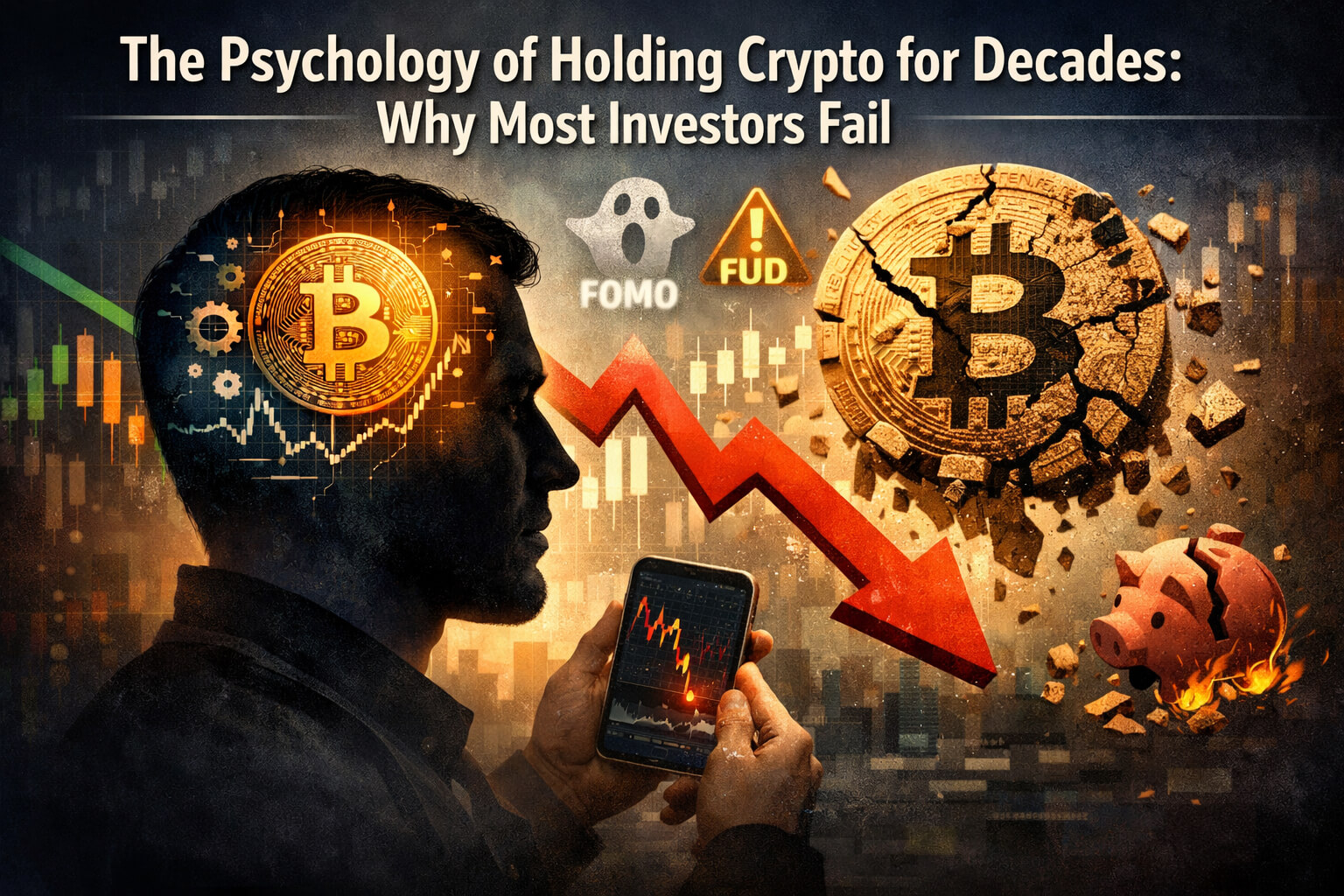
Most people who buy crypto say they’re in it for the long term. Almost none of them actually are.
A ChainPlay survey found that 87.6% of crypto investors cite long-term potential as their main reason to buy. Yet only 33.4% hold their investment for more than one year. The rest sell. Usually at the wrong time, for the wrong reasons.
This is not a market problem. It’s a psychology problem. And understanding it is the difference between building real wealth and repeatedly starting over.
Most People Say They’re Long-Term Investors. But Aren’t
The gap between what investors say and what they actually do is the defining pattern of crypto markets.
You tell yourself you’re holding for five years. Then Bitcoin drops 40% in a week. Suddenly, you’re checking your phone every hour, refreshing price charts, reading Reddit threads predicting zero. Three days later, you sell.
That decision wasn’t driven by analysis. It was driven by fear. And the moment you sold, you locked in a permanent loss that a patient investor would have recovered from.
This cycle repeats across every market downturn. The same investors who bought on conviction sell on emotion, then buy back in again near the next peak. It’s expensive. It’s exhausting. And it’s almost entirely avoidable.
The Emotions That Make You Sell Too Early
Five psychological forces push investors out of positions they should hold. Each one feels rational in the moment. None of them are.
The 5 emotions that kill long-term holding
- FOMO (Fear of Missing Out): You see a coin surge 200% in a week. You buy near the top because you can’t stand the idea of missing it. The price corrects. You sell.
- FUD (Fear, Uncertainty, and Doubt): Negative news floods social media. You don’t know what’s real. You sell to feel safe. The price recovers. You missed it.
- Loss Aversion: Research shows the pain of losing money is twice as powerful as the pleasure of gaining the same amount. A 30% drop feels catastrophic, even when it’s temporary.
- Greed: You hold a 5x gain waiting for 10x. The market turns. You end up with a loss instead of a life-changing win.
- Anchoring: You bought at $60,000. It’s now at $25,000. Every decision you make is filtered through that entry price, not through what the asset is actually worth today.
These emotions don’t signal weakness. They signal that you’re human. But in crypto, acting on them consistently will cost you far more than any single bad trade.
The Behaviors That Separate Winners from Everyone Else
Long-term holders don’t have better information. They have better habits. The table below shows exactly where the difference lives.
| Behavior | Most Investors | Long-Term Holders |
| Decision-making | Emotional, reactive | Planned, rules-based |
| Response to a crash | Panic sell | Hold or buy more |
| Reason for buying | Hype or FOMO | Conviction in fundamentals |
| Time horizon | Days to months | Years to decades |
| Information diet | Social media, headlines | On-chain data, fundamentals |
| Trading frequency | High, chasing moves | Low, set and forget |
The most important column is the right one. Long-term holders aren’t passive or uninformed. They’re deliberate. They decided in advance how they would behave, and they stuck to it.
Why the Crypto Market Makes It Especially Hard to Stay Calm
Crypto is not just volatile. It’s structurally designed to trigger your worst instincts.
Traditional stock markets close at night and on weekends. That break forces patience. You can’t panic-sell on a Saturday. You have 48 hours to calm down and think clearly before markets reopen.
Crypto never closes. The market runs 24 hours a day, seven days a week, 365 days a year. Every dip is available to act on immediately. Every tweet from an influential account hits in real time. Every piece of bad news is one tap away from becoming a sell order.
Social media makes this worse. Platforms like X (formerly Twitter), Reddit, and Telegram amplify fear and greed at scale. When FUD spreads, meaning fearful, uncertain, or doubtful narratives flood communities, it triggers a chain reaction. Investors sell, prices drop further, more investors sell. The psychology becomes self-fulfilling.
Understanding this structure doesn’t protect you automatically. But it helps you recognize the pattern when you’re inside it.
The Biggest Mistakes Investors Make and Why They Keep Making Them
These aren’t rare failures. They repeat across every market cycle, from every type of investor, at every experience level.
- Buying at the peak. FOMO drives investors into assets after they’ve already run up sharply. They buy high, the price corrects, and they sell low. This pattern repeats.
- Panic selling during crashes. A 40% drop feels permanent. It rarely is. Selling turns a temporary loss into a locked-in one. The investor who sold Bitcoin at $16,000 in 2022 didn’t recover those gains.
- Checking prices constantly leads to reacting constantly. Each reaction costs money in fees, taxes, and missed compounding. Inactivity is often the better strategy.
- Confusing holding with ignoring. HODLing, the crypto term for holding through volatility, only works if the underlying asset still has strong fundamentals. Holding a failed project isn’t patience. It’s denial.
- No exit plan. Most investors define when to buy. Almost none define when to sell. Without pre-set rules for taking profits or cutting losses, every decision becomes emotional and situational.
- Repeating the same emotional patterns. Each time an investor panic-sells and later regrets it, the behavior reinforces itself. The next cycle, it happens faster and more automatically, just like any habit.
How to Actually Hold for the Long Term: Practical Mindset Shifts
The investors who hold for years don’t rely on willpower. They build systems that remove decisions from moments of high emotion.
Start with your reason for buying. Before you buy anything, write down exactly why you’re buying it and what would have to change for you to sell. If you can’t answer that question clearly, you’re not investing. You’re speculating. Conviction that’s based on fundamentals holds better than conviction based on price momentum.
Use dollar-cost averaging (DCA). DCA means investing a fixed amount at regular intervals, say $100 every week, regardless of what the price is doing. This removes the pressure to time the market. You buy more when prices are low and less when they’re high, automatically averaging your cost over time.
Limit how often you check your portfolio. Checking prices daily doesn’t give you better information. It gives you more opportunities to act emotionally. Many long-term investors set a rule: check once a week, or once a month.
Define your crash plan before a crash happens. Ask yourself now: if this asset drops 50%, what will I do? If you don’t have a written answer, your answer in that moment will be fear. Write the plan when you’re calm. Follow it when you’re not.
Separate your crypto allocation from money you need. If you invest money you might need for rent or emergencies, every price drop becomes a threat to your stability, not just your portfolio. That pressure makes rational decisions impossible. Only hold what you can afford to leave untouched for years.
The investors who succeed in crypto over decades are not the ones who predicted the market correctly. They’re the ones who controlled their own behavior when the market was at its most chaotic.
That’s a skill. And like any skill, it’s learnable.